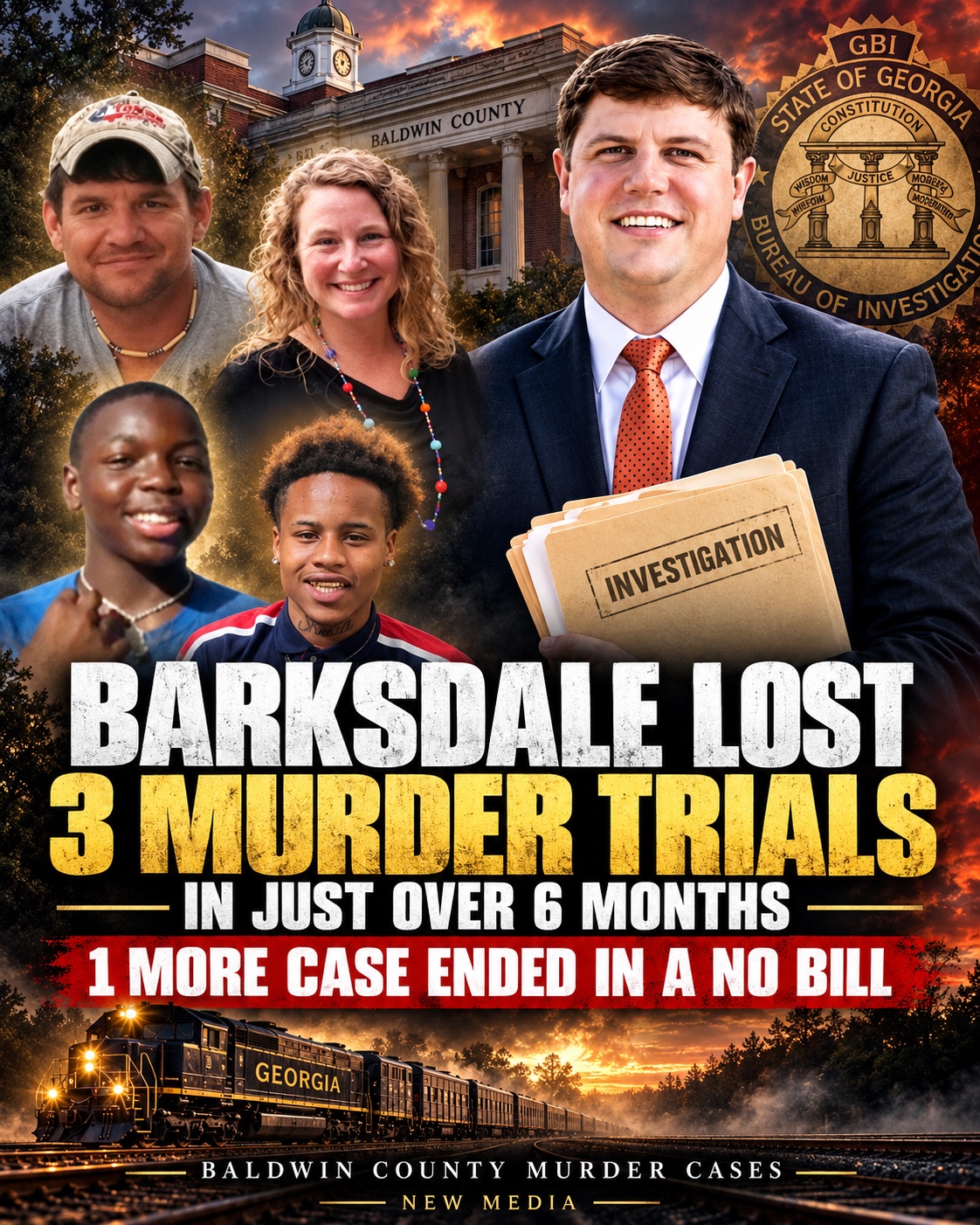
T. Wright Barksdale has time to come into New Media’s comment section and accuse me of clickbait. He says I want clicks. He says I should have called his office. He says he’s sure I know where the courthouse is.
Okay. Let’s talk about what happens inside that courthouse.
Barksdale became district attorney in 2020. Within roughly six months, his office lost three murder trials to acquittals.
Dequanis Parks was acquitted in the murder case involving Cuatez Jones. William “Chad” Weaver was acquitted of all charges in the death of Jody Harold Raley. Marcus Allen Lillard was acquitted of all charges in the death of UGA professor Marianne Shockley. Reports described those as three murder trial losses for the district attorney’s office between November 2021 and April 2022.
An indictment is not a conviction. You can indict a ham sandwich. An indictment only means a grand jury found probable cause to move forward. A conviction requires the prosecution to prove the case beyond a reasonable doubt.
So the question is simple. How did these cases get to trial, yet end with acquittals?
And what happened to the families afterward?
Then there is the Nytavious Stone case. This case is separate from those three acquittals. Micha Brown was charged in connection with Stone’s death, but a grand jury returned a no bill after prosecutors presented the case. That means the case was presented, but the grand jury did not indict him.
Micha Brown’s twin brother, William Brown, was charged with aggravated assault. According to Barksdale, William Brown was sent to prison through a probation revocation connected to an aggravated assault involving Stone before the shooting. That is not the same thing as a murder conviction, and a probation revocation is not proof that someone was convicted of murder.
The public needs to understand that distinction. A person can face probation revocation based on an alleged violation of probation conditions without being convicted of any new charge. In the Lillard matter, the acquittal was followed by a separate probation revocation proceeding.
So now we have three murder acquittals in a short period of time, plus another murder case where the grand jury returned no bill.
That does not automatically prove misconduct. It does raise questions about charging decisions, trial strategy, evidence, preparation, and prosecutorial judgment.
Those are legitimate questions for an elected district attorney.
Barksdale wants to call New Media clickbait for asking them. But what exactly is the answer? Is the answer the GBI? Is the answer the FBI? Is the answer a referral, a recusal, or another investigation?
When there are alleged financial irregularities at the Baldwin County courthouse, the matter gets referred elsewhere. When there are questions involving the clerk’s office, Barksdale recuses himself and sends the matter to another agency.
But Barksdale is still the elected district attorney for the Ocmulgee Judicial Circuit. He has prosecutorial authority. If he believes something criminal happened, why is the public always being told to wait on another agency?
And while he has time to come into a journalist’s comment section and question motives, what level of effort is being used to pursue answers for families who lost loved ones?
Maybe Barksdale’s family name helped open the door. Maybe his education and experience helped keep him there. But public office is not a family heirloom. Once someone is elected, the question becomes what they are doing with the power they were given.
New Media is asking what Barksdale has done with prosecutorial authority, what his office has achieved, what cases were lost, what cases were never indicted, what cases were referred away, and what families are still waiting for answers.
This is not about whether Barksdale knows where the courthouse is. It’s definitely not about whether a private citizen knows where it is. It’s about the people who were elected to work at the courthouse. Do their job.