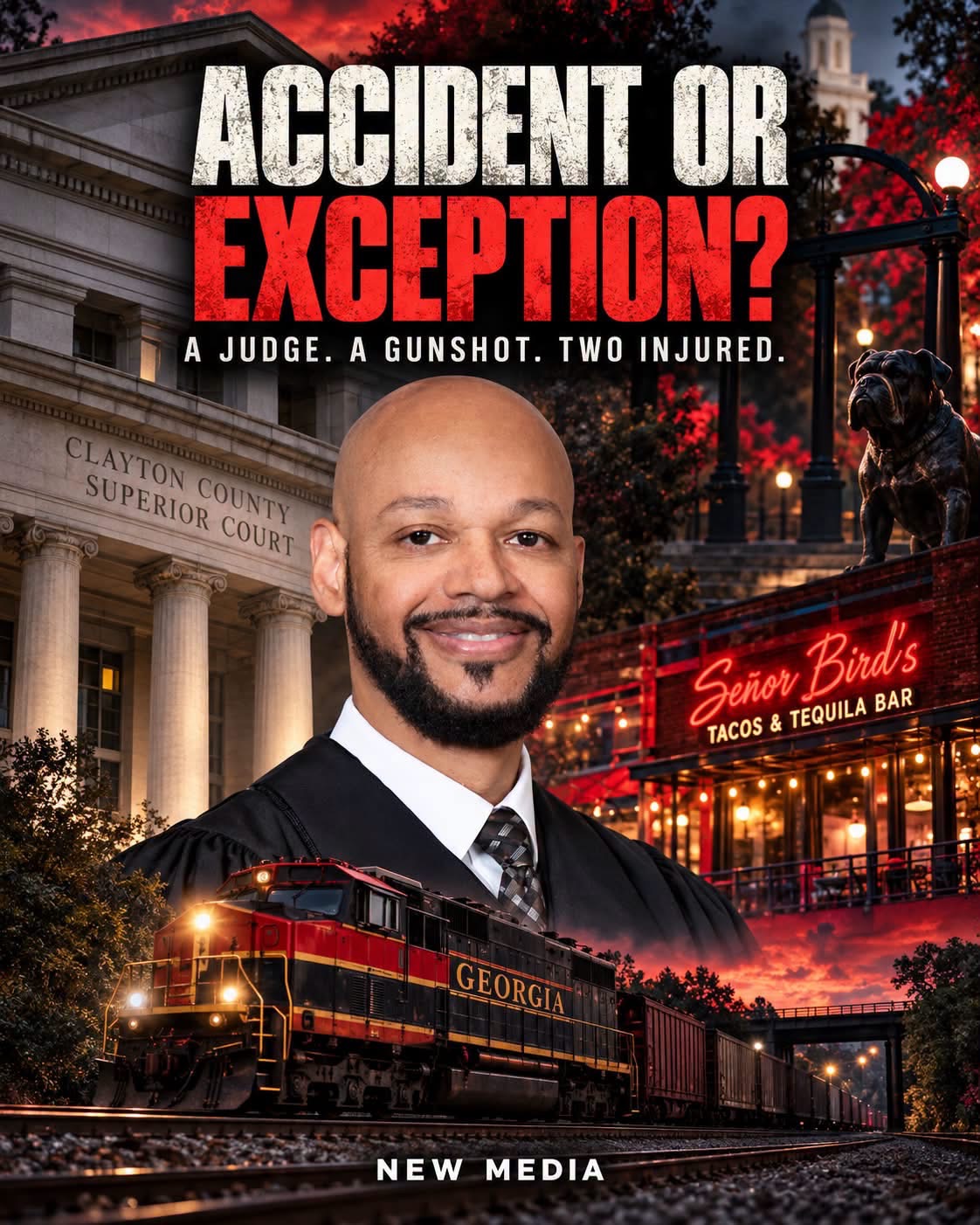
Clayton County Superior Court Judge Aaron Mason is at the center of a serious question about accountability, privilege, and equal treatment under the law.
According to public reports, Mason was inside a restaurant in Athens when the firearm in his pocket discharged as he reached for his wallet. The bullet struck the floor, sending tile or floor debris into the dining area. A 22-year-old customer suffered a cut to the forehead, and two women also reported injuries. This was not a gun sitting safely on a table. This was a loaded firearm in a judge’s pocket inside a crowded restaurant.
The public explanation is that the gun fired accidentally. But an accident does not erase the consequences when somebody is injured. For an ordinary citizen, a firearm discharging inside a restaurant and injuring people could lead to detention, charges, a booking photo, and an investigation for reckless conduct.
So why was Judge Mason not charged?
Mason is not just another citizen. He is a sitting Clayton County Superior Court judge. He has served as a prosecutor, an attorney, and a member of the judicial system. He understands how police investigations become criminal charges, how warrants are issued, and how defendants are processed. Even though he lost his reelection bid, he remains a sitting judge until his term ends.
That position matters. It creates influence, credibility, and relationships. It also creates the possibility of receiving a level of institutional respect and benefit of the doubt that an ordinary citizen may never receive.
This is not about whether Mason intended to shoot anybody. The issue is whether placing a loaded firearm in his pocket inside a crowded restaurant showed a reckless disregard for public safety. The gun discharged. The floor was struck. Debris injured people. That is not just a private mistake. It became a public safety incident with victims.
Now compare that to Baldwin County Chief Magistrate Judge Shane Geeter. Geeter was arrested and booked on DUI and failure to maintain lane charges after a Georgia State Patrol trooper observed him veering outside his lane. The DUI was reduced to reckless driving. He was sentenced to probation, and that probation was closed the same day.
That is not speculation. That is what happened in the court file.
Then look at the recent tragedy in Milledgeville. Police say three children gained access to a firearm, and a three-year-old lost their life. The father was taken into custody for questioning, the firearm was seized, and charges are pending.
These cases are not identical. One involves a child’s death. One involves injuries inside a restaurant. But all of them raise the same question: when a firearm is handled carelessly and somebody is harmed, does the system respond the same way when the person involved is a regular citizen, a chief magistrate judge, or a sitting Superior Court judge?
This is not about race. It is not about attacking a Black judge. It is about position. It is about whether the title, the robe, the relationships, and the influence surrounding a person change how the system treats them.
We cannot demand accountability from regular citizens while giving people in power explanations, reduced charges, probation, and immediate closure.
If justice is supposed to be blind, the public should not have to wonder whether it can still recognize a robe.