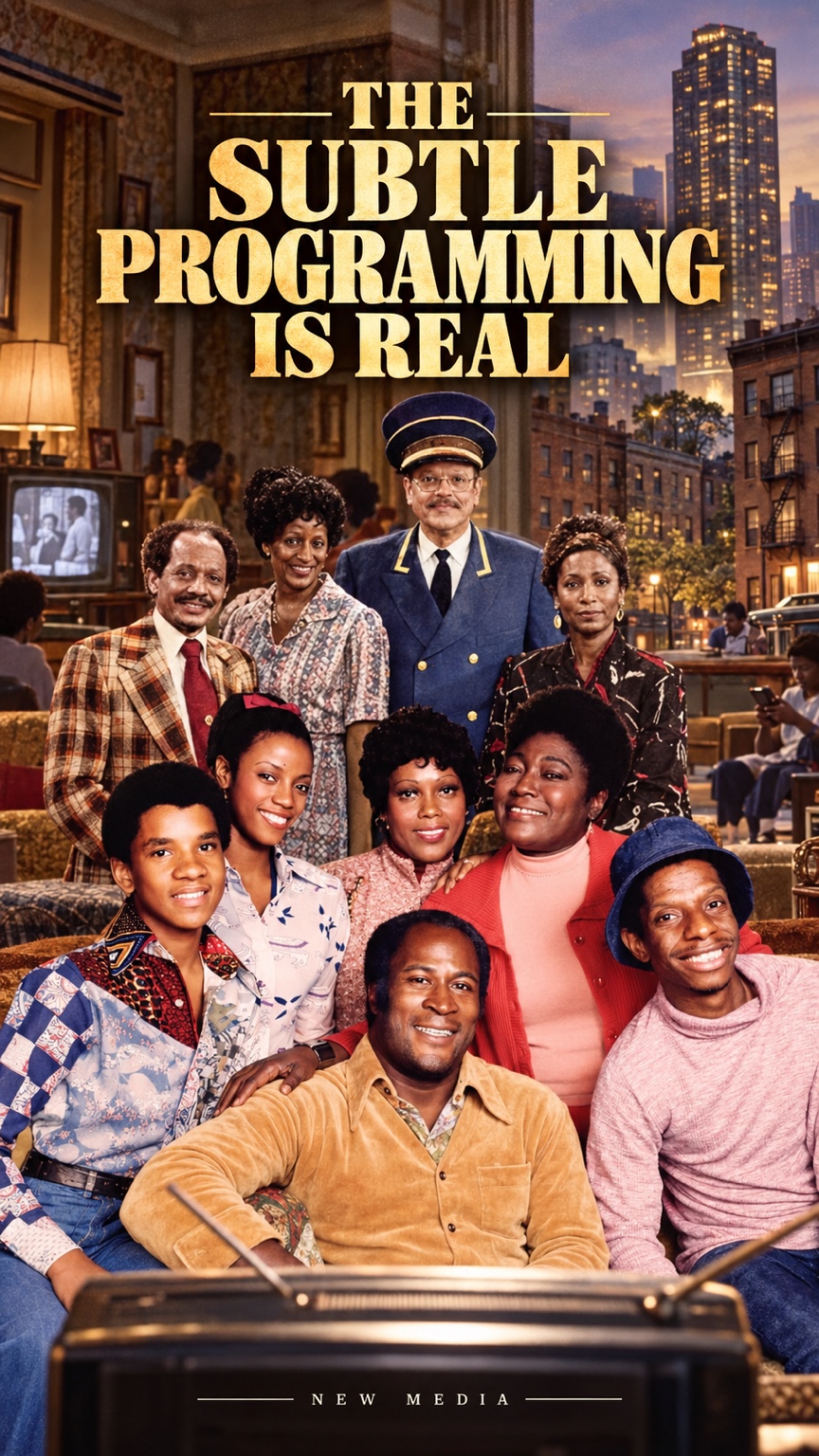
There was a certain feeling when Good Times came on television. The living room would settle down. The opening music would fill the house. The Evans family would appear on the screen, smiling, moving through Chicago, trying to make something out of nothing. For a lot of us, that song still carries a deep nostalgia. It takes us back to family, laughter, struggle, and a time when everybody gathered around the same television.
I love Good Times. That’s what makes this conversation complicated. The show gave us Black family, Black humor, Black love, and Black resilience. We saw ourselves in that apartment. We recognized the arguments, the sacrifices, the parents trying to protect their children, and the children trying to escape the conditions they were born into. The show had value. Still, as I got older, I started hearing that theme song differently.
The song describes layoffs, hard times, meeting payments, staying out from under pressure, keeping your head above water, then making a wave whenever you can. It mentions temporary layoffs, yet the chorus keeps calling those conditions Good Times. That isn’t prosperity. That’s temporary relief. That’s surviving pressure long enough to experience another day without completely drowning.
The message is subtle because the music is uplifting. The family is loving. The audience is laughing. The struggle is wrapped in warmth until hardship begins to feel familiar. The song doesn’t tell you to build wealth, control your circumstances, or escape the water. It teaches you to celebrate keeping your head above it.
Then came The Jeffersons, with a completely different message. The theme celebrated “movin’ on up,” moving toward the East Side, toward a luxury apartment, toward what the song described as a piece of the pie. Suddenly, success meant elevation. It meant leaving the old neighborhood, entering a high rise, owning businesses, wearing the money, and living near white neighbors.
There’s nothing wrong with upward mobility. The question is who defined success for us. Why did television make it appear that Black people had finally made it when they moved away from the struggle, entered white spaces, gained material wealth, and climbed closer to the American dream? George Jefferson was successful because he had escaped the place that represented where he came from. The apartment represented proof that he had arrived.
One show taught us to call survival a good time. Another taught us to call elevation success. Both ideas entered the mind through music, images, characters, repetition, and emotion. That’s how programming works. It doesn’t always come through somebody standing in front of you, telling you exactly what to believe. Sometimes it comes through a message repeated so often that it becomes familiar. Once something becomes familiar, the mind begins to treat it as normal. Once it feels normal, people stop questioning it.
Somebody chooses the setting. Somebody creates the character. Somebody writes the dialogue. Somebody decides what the family looks like, what success looks like, what failure looks like, what relationships look like, and what the community looks like. The audience may understand that it’s fiction, but the mind still absorbs the pattern. We can know something isn’t real while allowing it to shape what feels real.
That’s why people can say television is fake, then carry resentment toward an actor because of a role that actor played. We can say the internet isn’t real, then allow a social media personality to influence where we eat, what we buy, how we dress, what we believe, and who we trust. Keith Lee can visit a restaurant, give his opinion, and create a line around the building. That’s influence. That’s why people are called influencers. They influence behavior, even when the subject has nothing to do with the essential needs of life.
The moment information becomes serious, people start questioning the motive. They’ll believe a fictional story because it entertained them, yet reject documented facts because they don’t like the person presenting them. They’ll repeat talking points they heard a thousand times without examining the source, then refuse to read an editorial because it has too many words. People will say, “I’m not reading all that,” even when the information could help them understand their own circumstances.
The television didn’t disappear. It got smaller. We used to sit in front of the television for hours. Now we carry the screen in our hands. The phone has become the television, the newspaper, the radio, the classroom, the marketplace, and the preacher all in one. We scroll through videos, headlines, opinions, advertisements, outrage, entertainment, and misinformation. The device changed. The influence didn’t.
I’m not saying one sitcom created the condition of the Black community. I’m not saying television explains every problem we face. That would be dishonest. I’m saying the mind is shaped by what it consumes most. Repeated images can influence what people expect, what they accept, what they desire, and what they believe is possible. If struggle is constantly presented as normal, then struggle can become part of a person’s identity. If success is constantly presented as proximity to wealth, status, whiteness, and material comfort, then people can begin chasing an image without ever asking who created the image.
That brings me back to the first line of my book, Be Great Today: “The mind controls all.” I started writing that book in 2016. I released it in 2020, before artificial intelligence became the everyday tool it is today. That book came from my mind, my experiences, my failures, my observations, and my effort to understand how thoughts become beliefs, how beliefs become behavior, and how behavior becomes reality.
I’m not bringing that up as a sales pitch. I’m bringing this up because I want people to understand the man behind New Media. Mr. Be Great Today. Lamar King Sr. My concern with what people allow into their minds didn’t begin when I started talking about records, dockets, systems, and public concerns. I was already writing about the mind years ago.
That book allows you to look at what I was thinking before New Media existed in its current form. Read it if you choose. Study it if you want. Then decide for yourself whether you can recognize the motives behind what I do today. This isn’t a new character I created for the camera. This is a continuation of a path I started walking years ago.
My role has changed. New Media is not the traditional programming you’re accustomed to seeing. I’m no longer interested in being another person trying to get information out first, fastest, or loudest. I’m interested in being the anomaly inside that ecosystem. I want to slow the story down long enough to ask what actually happened. I want the documentation. I want the paperwork. I want the audio, the timeline, the record, and the facts that survive after the emotion wears off.
New Media isn’t here to give you the political angle, the racial angle, the socioeconomic angle, or whatever version of the story gets the most attention. We want the truth as far as the record can establish it. Not the truth that makes the best headline. Not the truth that protects somebody’s image. Not the truth shaped by whoever got there first.
The subtle programming is real. It works through repetition, emotion, nostalgia, familiarity, fear and framing. It teaches people what to desire, what to accept, what to be afraid of, what to imitate, and what to dismiss. The mind controls all because everything we create begins as a thought. If you don’t control what enters your mind, something or somebody else will help control what comes out of it.
That’s why this conversation started with Good Times, but it ends much bigger than a sitcom. It ends with the mind. It ends with the ideas placed inside a generation. It ends with the responsibility to examine what we’ve been taught to call normal, successful, entertaining, real, and true.
In a world built on competing ideologies, manufactured outrage, instant opinions, and information designed to control what people believe, New Media’s goal is to stand alone. Not because I believe I’m always right, but because I believe the truth deserves a fair chance to speak before everybody else starts telling you what to think.