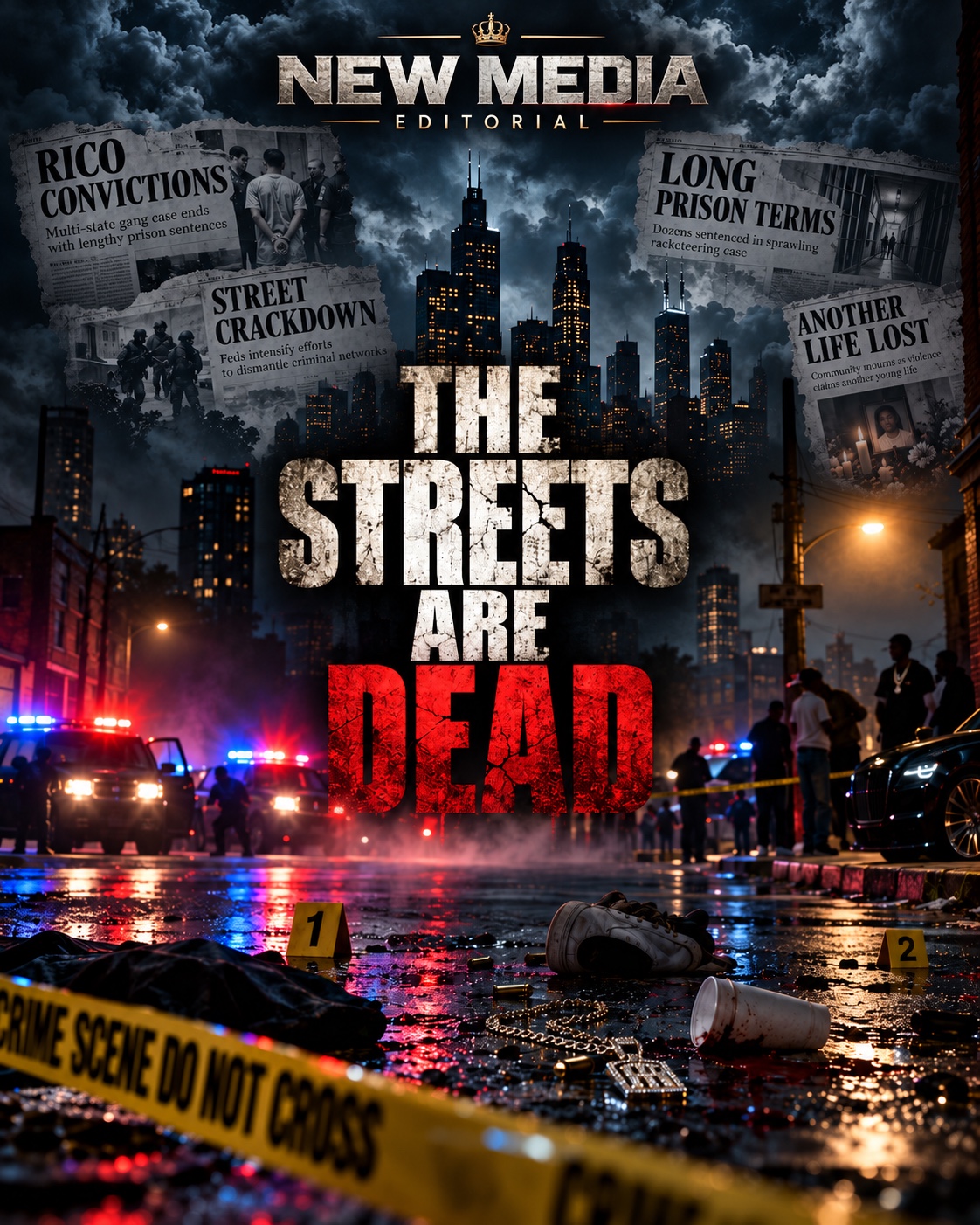
THE STREETS ARE DEAD.
A New Media Editorial | Be Great Today
You gotta be one confused young man or woman to believe you’re gonna spend the next 5 or 10 years selling drugs, running with gangs, popping bottles, putting that shit on, and living like every day is a music video without eventually paying a price. Man, those days are over. And truthfully, the streets were never what people made them out to be. They were violent in the 1980s, violent in the 1990s, and violent in the early 2000s. The difference is that today, the entire landscape has changed. And if you’re still looking at the streets as some kind of long-term career opportunity, somebody needs to have a serious conversation with you.
1. THE STREETS AREN’T WHAT THEY USED TO BE.
Everybody has a camera. Everybody has a phone. Surveillance systems are everywhere. Drones, digital footprints, text messages, social media posts, cooperating witnesses, and RICO prosecutions have completely changed the game. You’re out here recording the very lifestyle that prosecutors may eventually use to put you in prison. And that old notion of everybody keeping it real? Man, you better wake up. When somebody is looking at 20 or 30 years, don’t assume they’re going to sacrifice their freedom to protect yours. That loyalty everybody talks about becomes a whole different conversation when federal agents start knocking on doors.
2. PRISON ISN’T THE EXPERIENCE THESE YOUNG PEOPLE IMAGINE.
I’ve seen enough of the streets and the correctional system to tell you that prison is not somewhere you want to spend any part of your life in the 21st century. Look at the conditions in correctional facilities across this country. Staffing shortages, overcrowding, sanitation problems, violence, and facilities struggling to maintain basic operations. You might walk into that institution with a drug conviction and an 18-month sentence, only to find yourself housed alongside somebody serving 3 life sentences for murder, kidnapping, or armed robbery. You were just trying to flip a little money, get yourself a section, pop some bottles, and put on for your city. Now you’re calling home asking somebody to send $20 through JPay or Cash App. The same people who were celebrating with you on Friday night have gone on with their lives, and you’re sitting behind a wall watching a calendar. And understand something else. Just because the judge gave you 36 months doesn’t mean somebody can guarantee you’ll live long enough to come home.
3. THE ECONOMICS OF THE STREETS DON’T MAKE SENSE ANYMORE.
Think about what you’re risking compared to the legitimate opportunities available today. People are building businesses from their phones, making money creating content, driving rideshare, learning trades, and finding ways to earn a living that didn’t exist 20 years ago. Hell, marijuana is legal in some form in much of the country, although that doesn’t mean everybody can legally sell it. The point is that the world has changed, and some of y’all are still risking decades in prison trying to chase an image that doesn’t even make financial sense. College isn’t for everybody. Entrepreneurship isn’t for everybody. But there’s something out here you can do that doesn’t require you to look over your shoulder every time a police car passes. And parents, don’t fool yourselves into believing your child is immune because you have a good job, a nice house, or both parents are present. The streets don’t discriminate. They’ll swallow your child whole and spit out nothing but bones.
4. THE COMMUNITY HAS TO START COMMUNICATING.
This is where I want the people in small-town America to pay close attention. In places like Milledgeville, Sandersville, Sparta, and Eatonton, the people involved in street activity aren’t necessarily strangers. Somebody remembers that young man when he was 8 years old. Somebody went to school with his mother. Somebody works with his uncle. Somebody knows his grandmother. That’s the unique thing about smaller communities. We know each other, but somewhere along the way, we stopped speaking to each other.
You’ve got hardworking people getting up every morning, going to work, raising their families, and trying to build something. Then you’ve got another element in that same neighborhood involved in drugs, gangs, and other street activity. Everybody knows who’s who. Everybody knows what’s going on. But there’s often this unspoken disdain between the 2 groups. The working people look at the street element like they’re nothing but trouble, and the people in the streets sometimes look at the working people like they think they’re better than everybody else. Nobody says anything. Nobody has a meaningful conversation. They live 3 houses apart, see each other every day, and might not have spoken in 10 years.
And guess who’s caught in the middle? The children.
While the adults are busy staying in their separate lanes, a 14-year-old is watching everything. He’s watching the guy on the corner with the expensive shoes, the jewelry, the car, and the attention. He’s hearing the music, seeing the videos, and listening to his friends at school. You can monitor everything on your child’s phone, but that doesn’t mean his friends have those same restrictions. By the time you discover what he’s been watching, who he’s been talking to, or what he’s experimenting with, that influence may have already taken hold.
And this applies to our young women just as much as our young men. Young ladies, everybody offering you attention isn’t offering you protection. Being around people involved in dangerous lifestyles can expose you to exploitation, violence, and situations you never imagined yourself being in. Don’t confuse being accepted by a group with being valued by that group. Your future is worth more than somebody else’s reputation.
But here’s something I’ve been thinking about when it comes to our communities. Instead of always fighting fire with fire, why not try fighting fire with water?
I’m not telling anybody to confront gang members or put themselves in danger. I’m talking about relationships that already exist, particularly in smaller communities where people have known each other for generations. Sometimes the person you’re looking down on is somebody you’ve known since childhood. And sometimes a simple, genuine conversation can accomplish more than 10 years of walking past somebody pretending they don’t exist.
You might be surprised what happens when somebody who knows you hears you say, “Man, that’s my son. He’s doing good in school. He’s playing ball. I’m trying to make sure he has a future. Look out for him, man. Don’t let him get caught up in this shit.”
That doesn’t mean you approve of what they’re doing. It doesn’t mean you’re responsible for stopping their criminal activity. And it damn sure doesn’t mean every person involved in the streets is going to respect your wishes. But we have to understand that the people involved in that lifestyle are still human beings. Some of them know better than anybody what that life costs. Some have already lost years of their lives, buried friends, or watched everything they worked for disappear. And some of them wouldn’t wish that experience on another child.
We spend so much time asking what law enforcement is going to do about the streets that we sometimes overlook what we can do to protect children before they ever become involved. And no, that doesn’t mean another program with a catchy name is automatically going to fix the problem. Sometimes it starts with people who already know each other finding a way to communicate without judgment, arrogance, or hostility. You don’t have to agree with somebody’s choices to recognize that their influence exists. And you can’t protect your children from an environment you refuse to understand.
Parents, start these conversations early. Don’t wait until your child gets arrested, gets jumped into something, starts carrying a gun, or becomes somebody you barely recognize. Pay attention to their friends, their interests, their behavior, and what they’re being exposed to. And don’t assume that because you’ve warned them about the boys on the corner, they automatically understand why they should stay away. Sometimes all you’ve done is make those boys more interesting.
And to the young people who think the streets are where they’re going to make their mark, understand this. The people you’re trying so hard to impress today aren’t necessarily going to be there when everything falls apart. That lifestyle can cost you your freedom, your health, your family, and ultimately your life. Some people make it out. Some people change their lives. But far too many end up in prison, addicted, exploited, or buried before they ever get the opportunity.
The streets are dead. And the saddest part is that some of our children are still standing in line trying to get in.
Be Great Today.