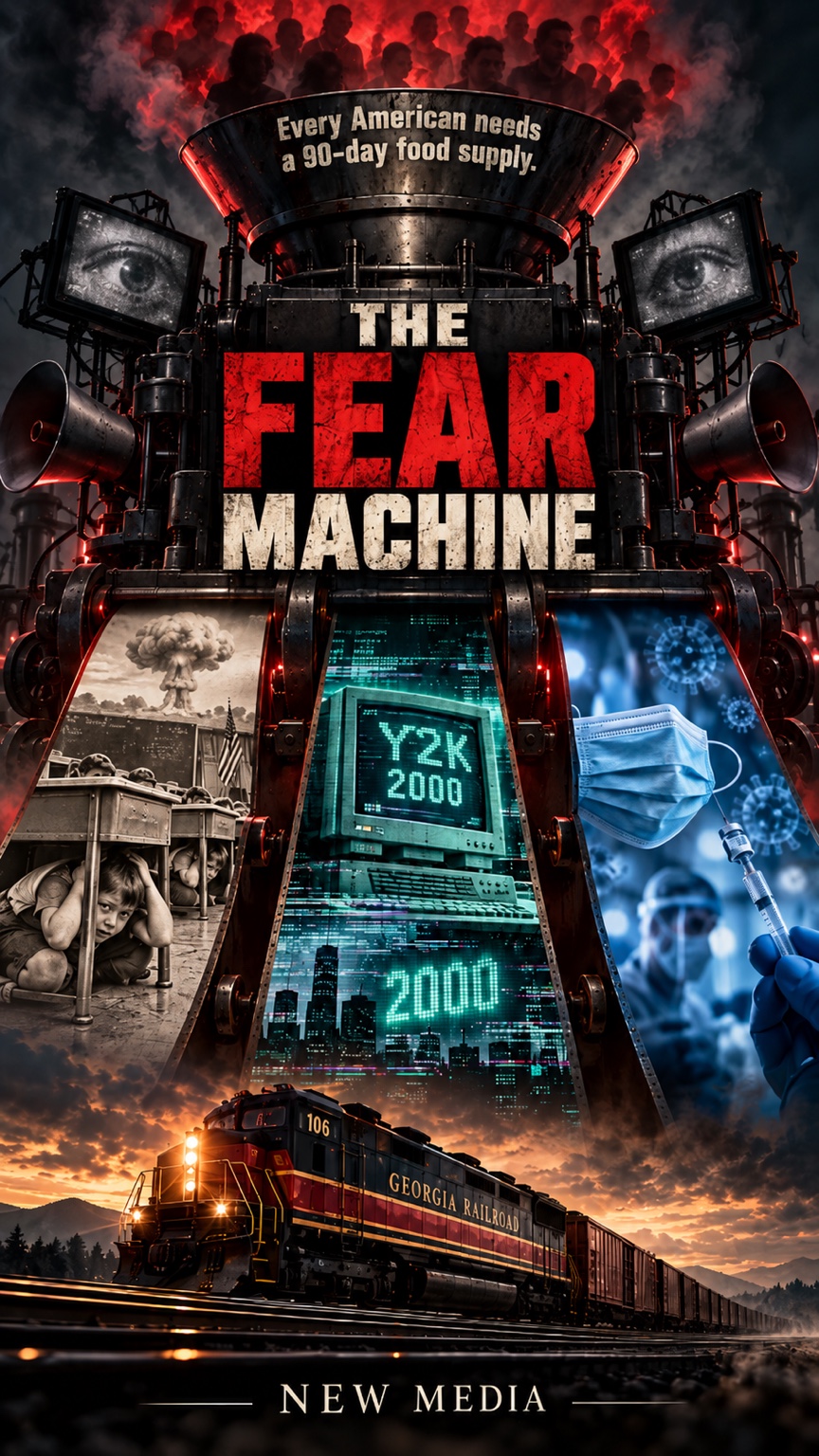
I swear, if I see one more damn post on social media telling people they need 90 days’ worth of food, generators, emergency supplies, or an underground bunker, I don’t know what I’m gonna do. Every time I turn around, somebody’s warning us about another catastrophe that’s supposedly headed our way. The power grid is going down. The food supply is about to collapse. The entire Southeast is getting ready to lose electricity. And people are sharing this stuff like they’ve received some kind of classified intelligence report. Nobody’s asking where the information came from. Nobody’s questioning who’s behind it. They’re just believing it, repeating it, and passing that same fear on to somebody else.
But see, this ain’t nothing new. This is the same old playbook that’s been used for generations. Go back to the 1950s and 1960s, when they had schoolchildren crawling underneath their desks, preparing for nuclear bombs that might come flying over from the Soviet Union. They called it duck and cover. Now, the threat of nuclear war was real, but somebody explain to me how hiding underneath a wooden school desk was supposed to protect a child from a nuclear explosion. Nevertheless, millions of Americans participated because that’s what they were told to do. And when you convince people that danger is right around the corner, you can get them to do just about anything.
Then came Y2K. Man, I remember that foolishness like it was yesterday. As we approached the year 2000, they had people convinced computers were going to crash, financial systems were going to collapse, and civilization might come to a screeching halt. Folks were buying new computers, generators, bottled water, and anything else they thought they needed to survive. Now, there were legitimate computer problems that needed fixing, and a whole lot of people worked to prevent those failures. But the way some of that information was presented, you would’ve thought the world was scheduled to end at midnight. And when that clock struck twelve, the world kept turning.
And don’t even get me started on COVID. I’m gonna plead the Fifth on that one. But I will say this much. People lost their lives, families suffered, businesses closed, and the entire country experienced something most of us had never witnessed before. And throughout that experience, people were expected to make decisions while information and recommendations continued to change. Some decisions were supported by evidence, and others deserved more scrutiny. But somewhere along the way, asking questions became controversial. And I don’t care who’s delivering the information. When something affects your health, your family, or your livelihood, you ought to be able to ask questions.
Now, here we are in 2026, and the fear machine has found something else to feed on. The Pentagon recently announced an initiative designed to help military bases operate independently if civilian infrastructure goes down. Then came reports about a goal of keeping those installations running for at least 90 days without outside support. That’s a military preparedness plan. It wasn’t an announcement that Americans needed to start filling their garages with canned goods. But somewhere between that report and somebody’s Facebook page, people started talking like the entire country was about to lose electricity. And just like that, another round of panic started making its way across social media.
And here’s what people need to understand. There’s a difference between preparing for something that could happen and predicting that something is going to happen. We’ve had hurricanes, winter storms, tornadoes, and power outages for generations. Being prepared for an emergency makes sense. But when somebody tells you the entire Southeast is about to go dark for 90 days, you ought to ask where they got that information. Because a military contingency plan isn’t proof of an approaching disaster, and somebody making a video with dramatic music in the background doesn’t make them an authority on anything.
But let me tell you something else about fear. There’s money in it. Companies sell generators, emergency food packages, survival equipment, and everything else people believe they’ll need when disaster strikes. And when people start worrying about losing electricity, businesses that manufacture backup power equipment can see increased demand. That’s not speculation about some secret conspiracy. That’s how consumer demand works. Now, I’m not saying these companies are creating the warnings, but I am saying there’s an entire industry that benefits when people become concerned about emergencies. And whenever fear starts driving people to spend money, it’s worth asking who’s profiting from it.
See, the fear machine doesn’t always have to invent something out of thin air. Sometimes all it has to do is take a legitimate concern, stretch it beyond what the evidence supports, and repeat it until people start treating speculation like fact. And social media has made that easier than ever. Somebody makes a frightening prediction, somebody else reposts it, and before long, thousands of people are discussing something nobody has actually verified. The more alarming the message, the more attention it gets. And in a world where attention generates revenue, fear has become some people’s business model.
And here’s what I find fascinating. Some of the same people who will question every document New Media publishes won’t think twice about believing a television personality or a social media influencer predicting the next catastrophe. Now, I want people to question New Media. That’s what you’re supposed to do. But apply that same standard to everybody else. A million followers don’t make somebody credible, and a familiar face on television doesn’t automatically make what they’re saying true. Evidence ought to matter more than popularity.
Because what happens when you spend your entire life preparing for things that might never happen? You become so consumed with tomorrow’s possibilities that you stop recognizing today’s opportunities. You’re worried about whether the electricity might go out 3 months from now, but you haven’t figured out how to bring some light into your own life today. You’re preparing to survive a disaster while allowing the fear of that disaster to dictate how you live. And that’s where the real damage begins. Not with what somebody convinced you to buy, but with what you’ve allowed fear to take away from you.
Now, don’t misunderstand me. I’m not telling anybody to throw away their emergency supplies or stop preparing for unexpected circumstances. Hell, I live in Texas. I know firsthand how quickly the electricity can go out. Preparation is wisdom. But panic ain’t preparation, and speculation ain’t evidence. There’s a reason the Bible talks about faith the size of a mustard seed. Faith doesn’t mean ignoring reality. It means understanding that uncertainty doesn’t have to control your existence. You can make responsible decisions without allowing every frightening headline to dictate your next move.
So before you share that next warning about a 90-day blackout, a worldwide collapse, or another catastrophe that’s supposedly headed our way, ask yourself one simple question. Am I sharing information, or am I spreading somebody else’s fear? Because every time you pass along something you haven’t verified, you become another moving part in the very machine that’s influencing you.
And I’m gonna leave you with this. They’ve spent generations teaching people how to prepare for the worst thing that could happen tomorrow. But how much time have they spent teaching people how to recognize the opportunities sitting right in front of them today? The most dangerous thing about the fear machine ain’t necessarily what it’s telling you to believe. It’s what happens when you stop believing in your own ability to think.
Mr. Be Great Today. New Media: King’s Insight. Where The Truth Will Never Be Silenced.