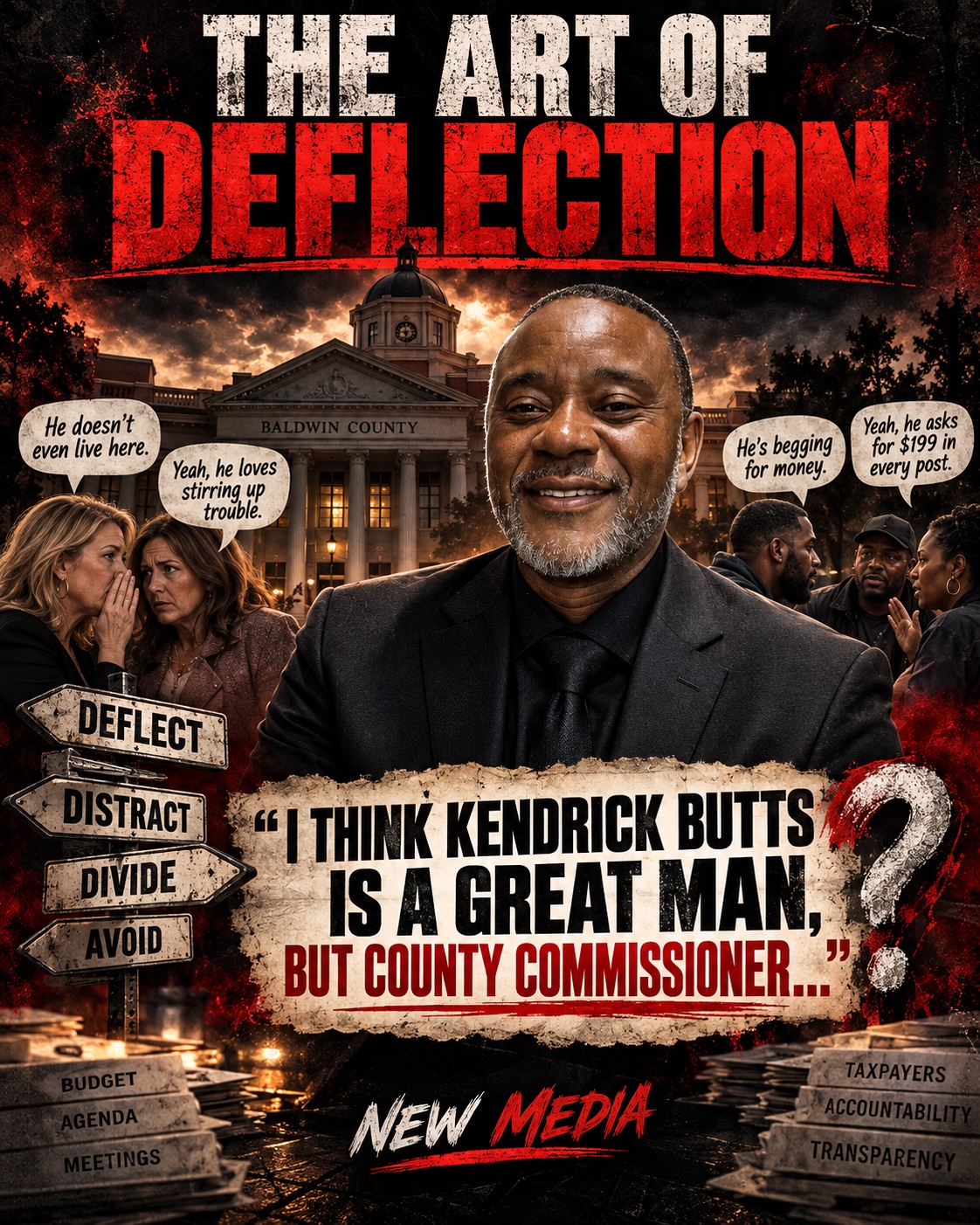
I think Kendrick Butts is a good man. As a matter of fact, I consider Kendrick a good friend. I’ve known him practically my entire life. I was born across the street from him in the Boddie Projects in Milledgeville, Georgia. Kendrick knew me before I knew myself. He’s a master electrician, and I’ve personally hired him to perform electrical work for me in the past. His work was phenomenal. If somebody asked me tomorrow whether I’d recommend Kendrick Butts as an electrician, I wouldn’t hesitate. But if you asked me whether I believe Kendrick Butts is doing a good job as chairman of the Baldwin County Board of Commissioners, my answer would be entirely different.
Based on the documentation I’ve examined, Baldwin County’s financial condition, and the decisions made under the current leadership, I believe the county needs an entirely new Board of Commissioners, including my friend Kendrick Butts. Now, does that mean I hate Kendrick? Absolutely not. Does that mean we’re no longer friends? No. Does that erase the good experiences I’ve had with him personally and professionally? Of course not. It simply means I can separate my personal relationship with somebody from my assessment of their performance in public office. Unfortunately, that seems to be something a lot of people struggle with.
One of the most common defenses I hear whenever New Media questions a public official is, “He’s a good man.” Everybody wants to tell you how long they’ve known him, what church he attends, or how he helped somebody’s family 20 years ago. And I’m glad he helped you. I’m glad he treated your family right. But what does any of that have to do with whether he’s effectively performing the duties of the office he holds? The exception isn’t the rule. Just because somebody did right by you doesn’t establish that everybody received the same treatment. What about the next person?
Being a good person and being a good public official are 2 entirely different things. Somebody can be a wonderful father, a dependable friend, and a respected businessman while falling short of the responsibilities of public office. That’s not a contradiction. And friendship shouldn’t require us to ignore what we believe is wrong. If your slip is showing, I’m going to tell you. If you’ve got a booger hanging out your nose, I’m going to tell you. If your breath stinks, I’m going to tell you that too. That’s what real friends do. I’m not going to smile in your face and pretend everything is fine simply because we’ve known each other for decades.
And this is bigger than Kendrick Butts. Since establishing New Media, I’ve covered people from practically every walk of life. We’ve revisited unsolved homicides, examined criminal proceedings, questioned law enforcement conduct, explored the Dixie Mafia, and investigated institutional failures. We’ve discussed Brandon Glenn, Kevin Bass, Roni Reaves, the Duplex City triple homicide, Dexter Lee Williams, and numerous other stories. Some involved people I knew personally. Others involved complete strangers. But I’ve noticed that the resistance becomes much more pronounced when the conversation moves from the neighborhood to the courthouse.
I can discuss a homicide on the South Side of Milledgeville, revisit something that happened in the Peach County, or examine a criminal case involving somebody from Sparta, and people generally focus on the story. But when I start discussing government contracts, county finances, tax increases, purchasing procedures, and officials who’ve occupied positions of authority for years, suddenly I’m a troublemaker. Now I’m stretching the truth. Now I’m stirring up trouble. And here comes one of my favorites: “He doesn’t even live here.”
Okay. And?
What does my residential address have to do with a $2 million government transaction? Does living in Houston change what’s reflected in Baldwin County’s financial records? Does my ZIP code determine whether purchasing procedures were followed or whether taxpayer money was spent appropriately? New Media has raised questions involving Roberts Land Management, a reported $2 million change order, and the contractual documentation supporting that transaction. I’ve also questioned an estimated $11,000 charge for financial records covering a single year. Those are matters that deserve answers supported by documentation, not arguments about where Lamar King happens to live.
But that’s the art of deflection. You introduce something unrelated to the original issue, get everybody arguing about that instead, and before long, nobody remembers what the original question was. Now we’re talking about when I moved away, whether I pay property taxes in Baldwin County, and why I’m still interested in the community where I was born and raised. Meanwhile, the questions about government spending haven’t gone anywhere. My residential address isn’t a supporting document for a government expenditure.
And I’ve noticed something else about how deeply this behavior has become embedded in our society. We don’t simply defend people we know. We’ve developed a culture where criticism of somebody we admire is treated as a personal attack against everybody who supports that person. Instead of evaluating the criticism, people immediately choose sides. They defend the personality, attack the person asking questions, and turn what should’ve been a discussion about performance into an argument between supporters and critics.
Now, think about what we’re teaching our children.
We constantly complain about the attitudes of today’s youth. We talk about children who can’t accept correction, young people who respond to criticism with hostility, and students who struggle to respect opinions different from their own. But what example are we setting when grown adults can’t tolerate somebody questioning a person they hold in high regard? How can we expect children to receive constructive criticism when they watch adults turn every disagreement into a personal confrontation?
Children don’t learn everything from what we tell them. They also learn from what we demonstrate.
And look at what we’re demonstrating.
We’re showing them that loyalty means defending somebody regardless of their performance. We’re showing them that criticism is something to fight rather than something to consider. We’re showing them that when somebody questions a person we admire, the appropriate response is to attack the critic instead of examining whether the criticism has merit.
Then we turn around and wonder why young people have such a difficult time accepting correction.
The same behavior plays out in politics every single day. Instead of holding elected officials accountable for their decisions, voters spend more time attacking other voters for exercising their constitutional right to vote. Somehow, responsibility shifts away from the person occupying public office and lands on the people who participated in the election.
And we see it right here in Baldwin County.
People will defend Scott Little because they believe he’s a good person. And I suspect many of those same individuals would offer similar defenses of Sammy Hall if he were still seeking office. The conversation becomes centered on personal loyalties rather than an independent examination of each official’s decisions and record. That’s the problem with treating public office like a popularity contest. We become so invested in defending the people we’ve supported that we struggle to acknowledge when their decisions deserve criticism.
And this isn’t exclusive to Baldwin County or one political party.
Look at what’s happening nationally. Democrats criticize Trump and then turn their frustration toward the people who voted for him. Republican voters do the same thing when a Democrat occupies the White House. Gas prices rise, groceries become more expensive, or families begin struggling financially, and instead of having a serious conversation about the decisions, economic conditions, and policies contributing to those problems, somebody inevitably says, “Look what you voted for.”
As if the person making that statement isn’t standing at the same gas pump paying the same damn price.
As if the cashier asks whether you’re a Democrat or Republican before ringing up your groceries.
As if the economy separates Americans according to which candidate they supported.
Think about how backward that is. We elect individuals to represent the public, but when those individuals make decisions we disagree with, we direct our anger toward the voters instead of examining the public officials. And those same people occupying positions of authority become secondary characters in arguments about their own performance.
We’ve become more comfortable holding voters accountable for voting than holding elected officials accountable for governing.
And that’s the most troubling part of the art of deflection. It doesn’t just change the subject. It changes who people believe should answer for the problem. The public official becomes the person people defend, while the citizen who asks questions or casts a ballot becomes the person we blame.
Meanwhile, we’re raising another generation watching adults demonstrate that personal loyalty is more important than independent judgment, that criticism should be met with hostility, and that accepting responsibility is optional when somebody else can be blamed.
So before we question why today’s children struggle with criticism, perhaps we should examine how the adults in their lives respond to it.
Because if grown people can’t distinguish friendship from performance, political loyalty from accountability, or legitimate criticism from personal hatred, what exactly are we expecting the next generation to learn?
And until we learn that distinction, the people responsible for making decisions will continue watching the people affected by those decisions fight among themselves.
NEW MEDIA | KING’S INSIGHT
Where the truth will never be silenced.