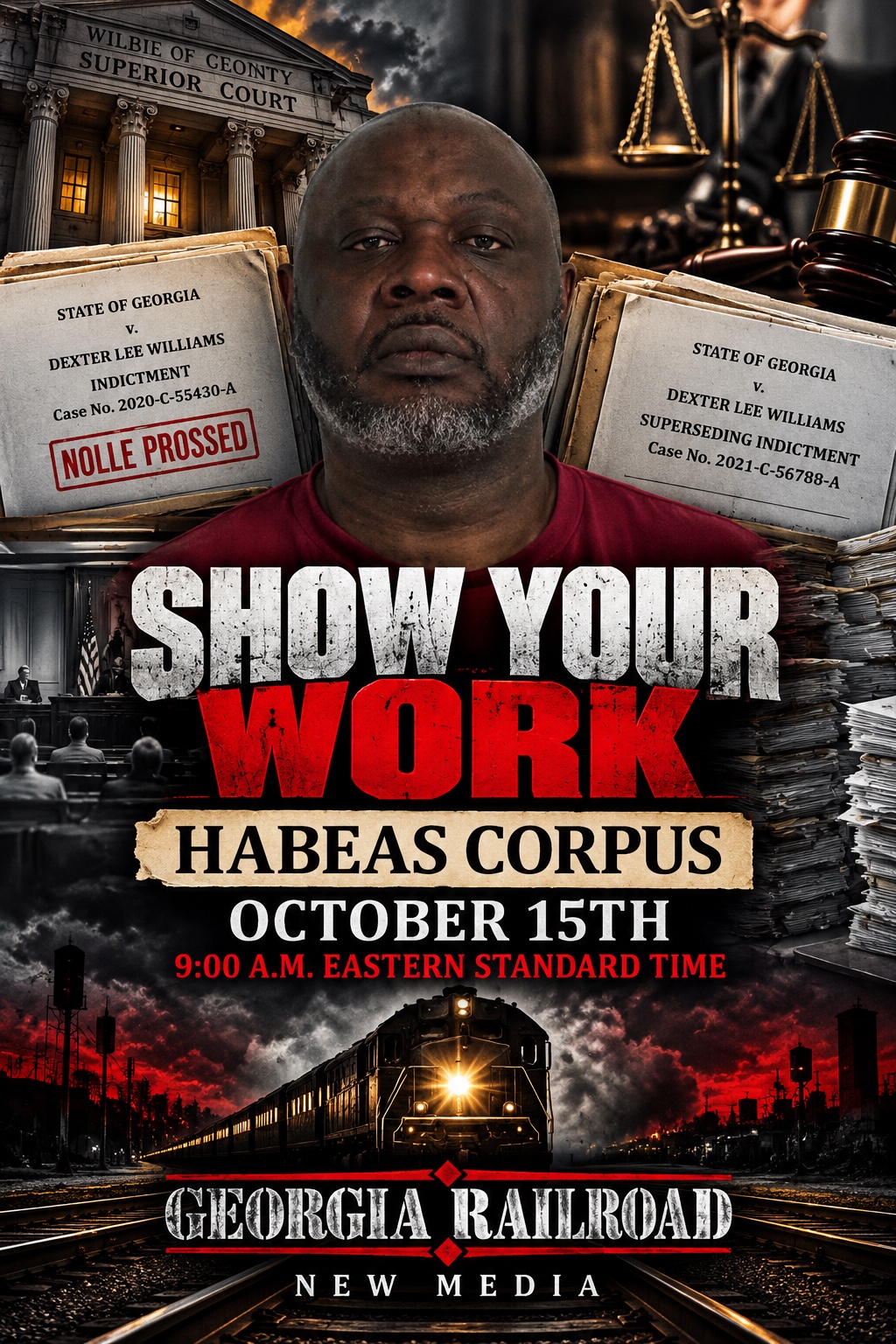
When you were in school, sometimes getting the right answer wasn’t enough. The teacher would look at that paper and say, “Show your work.” That’s probably the simplest way I can explain what October 15 means for Dexter Lee Williams. At 9:00 a.m. Eastern, Dexter returns to court for another habeas corpus hearing, and despite all the complicated legal terminology surrounding this case, the basic question we’re following is much simpler: Can the official record show how we got from the beginning of this prosecution to the conviction that put this man in prison?
Dexter has already been convicted. A jury returned that verdict. Habeas corpus isn’t simply another trial to determine whether Dexter did it or didn’t do it. Under Georgia law, habeas allows a person imprisoned under a state-court sentence to challenge substantial denials of constitutional rights in the proceedings that produced the conviction. That’s important because there’s a difference between saying “this man was convicted” and being able to reconstruct from the official record exactly how that conviction happened. That’s where Dexter Williams’ case gets complicated.
On March 4, 2020, Dexter Lee Williams was arrested in Bibb County, Georgia, during the events associated with what law enforcement called Operation Clean Sweep. That operation involved approximately 40 kilograms of cocaine and approximately $280,000 in cash. But there’s another date that belongs right behind March 4. According to the Bibb County documentation New Media obtained, the charges against Dexter there were dismissed on April 8, 2020, just over a month after his arrest. That dismissal doesn’t erase what happened March 4, nor does it by itself answer what another jurisdiction could later allege as part of a RICO prosecution. But if we’re going to show the work, it belongs on the timeline.
Then, on November 3, 2020, Dexter was indicted in Houston County under case 2020-C-55430-A, along with multiple co-defendants, in a massive RICO prosecution. That original indictment alleged a racketeering pattern extending through March 4, 2020. So follow this carefully: Dexter is arrested in Bibb County on March 4. The Bibb County charges are dismissed April 8. Months later, Houston County indicts Dexter and multiple other defendants under RICO, and the alleged racketeering period in that indictment runs all the way through March 4, the date of that Bibb County arrest.
Then came COVID, speedy-trial litigation, motions and delays. The case continued moving through Houston County until almost a year after the original indictment, when something significant changed. On October 12, 2021, Dexter was re-indicted under case 2021-C-56788-A. This time, Dexter stood alone. The defendants who had been charged alongside him under 55430 weren’t defendants alongside him under 56788. Dexter had been taken out of that original multi-defendant indictment and placed into an indictment by himself.
But the names weren’t the only thing that changed. The dates changed too. The original indictment alleged racketeering activity continuing through March 4. The new indictment stopped on March 2. The March 4 predicate acts associated with Dexter’s arrest were taken out. The March 4 drug allegations were no longer predicate acts in the new indictment. The original RICO indictment reached through the arrest. The new one stopped 2 days before it. Put the two indictments beside each other and look at the dates: March 4 became March 2.
And now the timing becomes critical. According to the court record New Media has assembled, by the time the re-indictment process was underway, the jury associated with the original prosecution had already been convened. So this wasn’t simply an old case ending one day and an entirely new prosecution beginning months later with a fresh jury that had never encountered the broader case. The prosecution moved forward against Dexter alone under 56788 while the other defendants remained connected to the original prosecution under 55430.
Yet the jury hearing Dexter’s case still heard evidence from that broader investigation. The approximately 40 kilograms of cocaine from March 4 came into the trial. The approximately $280,000 in cash came into the trial. Co-defendants from the broader RICO investigation were allowed to testify. But here’s the distinction that matters: those co-defendants testified about their involvement in the broader operation. Based on the testimony New Media has reviewed, they didn’t testify that Dexter supplied them drugs, sold them drugs or personally conducted those alleged transactions with them. They explained their own involvement while they themselves remained tied to the broader prosecution under the original indictment.
So who actually testified against Dexter Williams? According to the trial record New Media has reviewed, the witness whose testimony actually implicated Dexter was then-Sergeant Matthew Moulton, the Houston County Sheriff’s Office narcotics investigator involved in the investigation. Moulton has since become Sheriff of Houston County. That distinction matters because it separates testimony about the larger alleged operation from testimony actually used to connect Dexter to it. The co-defendants told the jury about their own participation. Moulton provided the investigative testimony the State used against Dexter Williams.
And that’s where the question gets narrower. What evidence actually connected Dexter Williams to the specific enterprise and predicate acts charged against him in the new indictment? Look at what happened on paper. The State originally had this enormous RICO prosecution involving Dexter, multiple co-defendants, numerous predicate acts and the March 4 operation. Then Dexter was taken out of that multi-defendant indictment and placed alone in 56788. The March 4 predicates were removed. The alleged racketeering period that originally continued through March 4 now stopped on March 2. Yet the jury still heard about the cocaine, the cash and the activities of people who remained connected to the broader prosecution.
New Media isn’t saying evidence from a broader investigation could never legally be admitted in Dexter’s trial. Whether particular evidence was properly admissible is a legal determination. We’re asking something more fundamental: Show us how it fits. If the March 4 predicates were taken out, show us what the March 4 evidence established about the charges that remained. If the co-defendants were taken out of Dexter’s new indictment, show us how their testimony established Dexter’s participation in the enterprise charged against him. And if those witnesses testified about their own conduct without implicating Dexter in that conduct, show us what evidence supplied that connection.
Then something else happened. On Friday, October 28, the original indictment involving Dexter was nolle prossed. The weekend passed. On Monday, November 1, the same jury returned its verdict against Dexter under the newer case number, 2021-C-56788-A. That’s the transition we’ve spent months trying to reconstruct from the paperwork: one indictment involving multiple defendants and extending through March 4, another indictment involving Dexter alone and ending March 2, evidence from the broader investigation presented to the jury, the original indictment nolle prossed on Friday, and a verdict under the newer case number on Monday.
And this is where “Show Your Work” becomes more than a title. When Dexter’s case eventually reached the Georgia Court of Appeals, his own appellate brief acknowledged something extraordinary about the appellate record: “This first indictment was not included in the record.” The brief was referring to 2020-C-55430-A. The same brief explains that Dexter was originally indicted with several co-defendants under 55430 and that the case was re-indicted on October 12 under 56788 with Dexter as the sole defendant. Then appellate counsel expressly acknowledges that the first indictment wasn’t included in the appellate record. 3-29-24 Brief of Appellant.pdf
Think about what that means for somebody trying to reconstruct this case from beginning to end. How do you completely examine the transition between these two prosecutions when the document showing exactly where the prosecution started isn’t included in the appellate record? And if the October 28 nolle-pros order wasn’t transmitted either, the questions become even more basic. What exactly did that order dismiss? When did 55430 stop governing Dexter’s prosecution? When did 56788 become the operative indictment before that jury? Was Dexter arraigned on 56788, or was arraignment properly waived? What indictment was presented to the jury? What charges was that jury instructed to decide? And where is the complete record showing exactly how the prosecution moved from one case number to the other?
Because there’s something the public sometimes forgets about our court system. The State is us. These are public courts, public prosecutions and public records. Judges, prosecutors, clerks and law enforcement exercise governmental authority on behalf of the people. That’s why the paperwork matters. If somebody is sentenced to spend decades of his life in prison, the public should be able to open that docket years later, follow the paperwork from beginning to end and understand exactly how the government arrived at that result.
You don’t have to believe Dexter Williams is innocent to ask these questions. You don’t have to believe he’s guilty either. That’s never been New Media’s position. We don’t argue innocence or guilt. We look at procedure, patterns and systems. The question on October 15 isn’t whether you like Dexter Williams, whether you remember the headlines from March 2020 or whether you remember seeing photographs of drugs and money. The question is whether the constitutional process that produced this conviction can withstand examination when the paperwork is placed on the table.
Dexter Williams has spent years asking the courts to examine that process. October 15 gives him another opportunity, and New Media will be watching the same paper trail we’ve been following from the beginning.
And after all of that, there’s one more piece of this story worth putting on the table. The co-defendants who remained under the original indictment ultimately entered guilty pleas under that original indictment. So the question remains: if the original indictment continued forward against those defendants, why was Dexter taken out and placed into a new indictment by himself? And Dexter wasn’t the only Williams publicly connected to this case. His wife, Loretta Williams, was arrested and publicly identified as a co-defendant, but she was never indicted. According to the records New Media has obtained, the charge against her was ultimately dismissed roughly a year after Dexter’s conviction for lack of jurisdiction. That belongs in the record too. Let that sink in.
We’re not asking anybody to take Dexter Williams’ word for it, and we’re damn sure not asking anybody to take New Media’s word for it. Open the docket. Put it on the scale. And show your work.
GEORGIA RAILROAD | NEW MEDIA