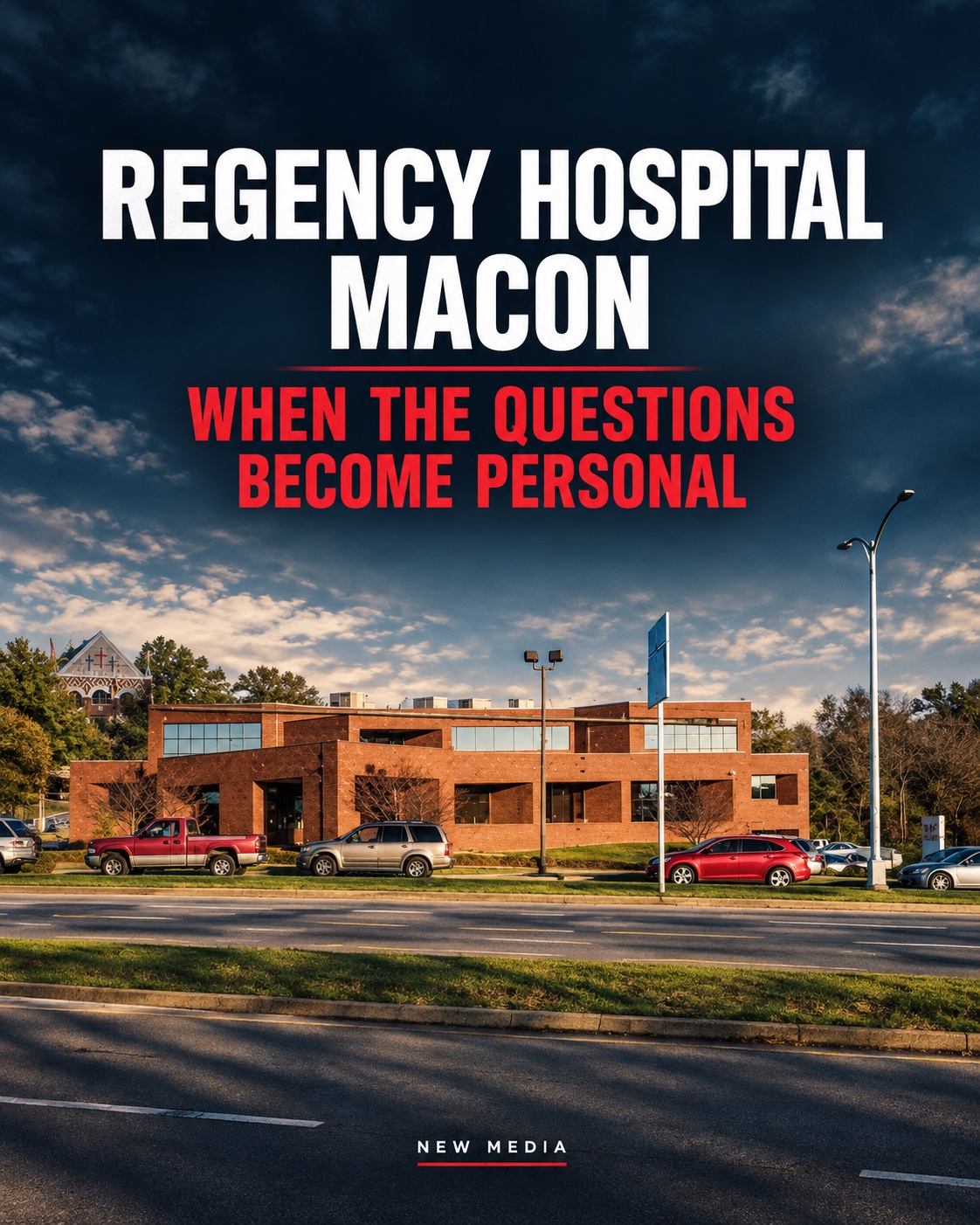
My family has now been touched by Regency Hospital in Macon twice in a matter of months. My cousin, Tresa Paschal, died there, and now my nephew is currently at Regency dealing with a serious problem involving his leg that could potentially result in him losing it.
So at this point, this isn’t just something I’m reading about online, and it isn’t just another hospital story passing through my timeline. This is personal. This is family. When the same hospital becomes connected to multiple serious medical situations involving people you love, you have every right to ask questions about the quality of care, the communication with families, and the decisions being made behind closed doors.
That’s why New Media is taking a deep dive into Regency Hospital in Macon, Georgia.
This isn’t about accusing every doctor, nurse, or employee of wrongdoing, because every patient who enters a long-term acute-care hospital is already dealing with serious medical conditions. But a difficult medical condition does not eliminate a family’s right to demand answers. When a patient’s condition worsens, when complaints appear to go unanswered, when communication breaks down, or when a loved one dies and the family still doesn’t understand what happened, those questions deserve more than a scripted response.
The public record already raises questions that cannot simply be dismissed as online complaints. In a Georgia malpractice case involving Regency Macon, a family alleged that a patient arrived with a swollen and damaged tongue, while multiple nurses documented that her condition continued to worsen. The lawsuit alleged that proper oral care and protective interventions were not provided, and the patient later developed an infection and required part of her tongue to be amputated. The case was dismissed because of Georgia’s medical-malpractice filing deadline, so the court never decided whether Regency was negligent. However, the allegations were supported by medical records and an expert affidavit, which means this wasn’t simply somebody leaving an angry review on the internet.
Public CMS-based data also lists at least 3 Regency Macon deaths associated with restraint or seclusion between 2020 and 2023. Now, that does not automatically mean restraint caused those deaths, and we are not going to make that claim without reviewing the actual records. But federal law requires hospitals to report deaths that occur during restraint, shortly after restraint, or when restraint may have contributed to a death. Therefore, those reports deserve to be examined, especially when we are trying to understand the hospital’s overall system of care.
The hospital’s quality data raises another concern because Regency Macon reported 10 central-line bloodstream infections compared with approximately 4.9 predicted infections. That produced a standardized infection ratio of 2.034, which was classified as worse than the national benchmark. That number doesn’t tell us what happened in every individual case, and the reporting periods vary. Still, when a hospital reports more than twice the expected number of a serious infection, it creates a legitimate question about infection control, staffing, training, and oversight.
Then there are the public reviews, where families describe ignored complaints, patients allegedly remaining in pain and discomfort, poor communication, absent case management, and experiences they describe as a nightmare. Those reviews are not proof of medical negligence, but they are leads, and they become more important when similar complaints appear across different families and different time periods.
What also stands out is that Regency repeatedly directs complainants to the same corporate compliance officer. That means the company is aware that families are raising serious concerns. But awareness is not the same thing as accountability, and a standard response telling people to contact compliance does not tell the public whether those complaints were investigated, whether they were substantiated, or whether anything changed afterward.
The public federal inspection record is limited as well. The available database lists 1 inspection from 2013 with 1 life-safety deficiency, but it also warns that some inspection reports were never uploaded and must be requested directly from CMS or the state. So the absence of a large public inspection history does not necessarily mean the hospital has a clean record. It may simply mean the public has not been given the complete record.
We do not argue innocence or guilt. We look at procedure, patterns, and systems.
That means New Media is going to examine the restraint reports, infection data, inspection history, complaint records, staffing, patient transfers, family communications, and the hospital’s internal response to complaints. We are going to ask how many complaints Regency Macon and Select Medical have received, how many were investigated, how many were substantiated, and what corrective action followed.
Most importantly, we are going to listen to the families, because families are often the first people to recognize when something is wrong. They are the ones sitting beside the hospital bed. They are the ones asking why their loved one is in pain, why nobody is answering the phone, why the condition keeps changing, or why the explanation doesn’t match what they are seeing with their own eyes.
My cousin Tresa Paschal’s death and my nephew’s current medical crisis have forced these questions directly into my own family. And because this is personal, New Media is not going to look away. We are not declaring a verdict before the evidence is assembled, but we are going to ask the questions, request the records, contact the regulators, and give Regency Hospital an opportunity to answer.
Because when families keep asking the same questions, those questions deserve to be investigated.
New Media: Where the truth will never be silenced.