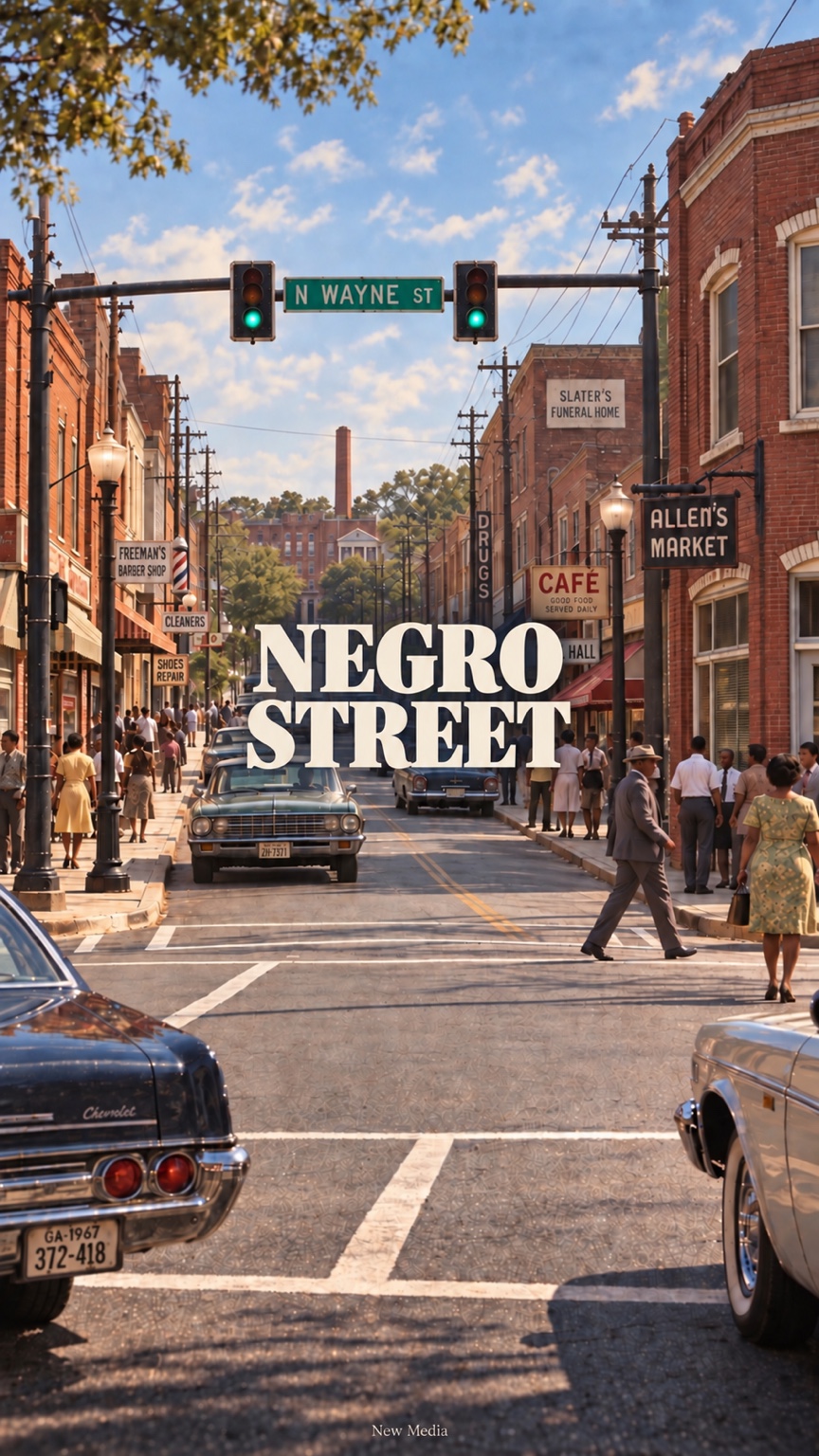
Before downtown Milledgeville was integrated, the city had two separate commercial worlds. The white downtown shopping district ran along Hancock and Wayne Streets, while McIntosh Street and the surrounding blocks became the center of Black commerce, culture, and community life. Locals knew it as The Strip, and many also called it Nigga Street.
This was more than a street lined with businesses. It was a complete Black commercial district. It was where people ate, shopped, got haircuts, bought medicine, repaired their shoes, arranged funerals, picked up groceries, listened to music, and gathered with people they knew. The dollar circulated inside the Black community because Black residents had built businesses that served Black families when white establishments refused to treat them with dignity.
Allen’s Market stood on the corner of McIntosh and Wayne. Slater’s Funeral Home began there before moving farther down Wayne Street. Freeman’s Barber Shop served the community, along with Jones Barbershop, Griffin’s Cleaners, shoe-repair businesses, restaurants, drugstores, grocery stores, pool halls, and other Black-owned businesses that made The Strip a living part of downtown Milledgeville.
Adams Restaurant was another important part of that community. It was a place where people could sit down, eat, talk, and spend time together. It represented the kind of everyday gathering place that made the district feel like home. These businesses were not isolated storefronts. They were connected through family, friendship, commerce, and community. Everybody knew somebody. The businesses supported one another, and the people supported the businesses.
The Strip also had entertainment and nightlife. A.T.’s Jazz Club, operated by Alfred Thomas, brought music and social life to West McIntosh during the 1970s. That part of downtown was not just about surviving segregation. It became a place where Black people created their own economic world, their own gathering places, and their own sense of pride.
This is also personal for me because this is the street where my mother and father met. So when I talk about The Strip, I am not talking about some distant historical location. I am talking about the place where my family’s story began. I am talking about a place my parents knew, where people built relationships, raised families, supported businesses, and found ways to enjoy life in a city that did not treat them equally everywhere else.
My father also told me about Culver Kidd’s Drugstore on South Wayne Street. Culver Kidd’s was one of the few white establishments in downtown Milledgeville where Black people were treated like human beings. Black customers could go inside, order food, sit down, and enjoy the same public space without being forced into segregated seating or made to feel unwelcome. It was a drugstore, but it also served food and functioned as a place where Black residents could receive a level of respect that was rare in the white commercial district.
That is why Culver Kidd’s mattered. It stood outside The Strip, but Black people remembered it as one of the few white-owned places downtown where they could walk in and be treated with dignity. Everywhere else, they went back to McIntosh Street, back to The Strip, back to the businesses and people who understood them.
The Strip was created during segregation, but it became much more than a response to exclusion. It became a Black economic and social center. The unity, the camaraderie, the love, and the circulation of the dollar created a community within the community.
Then downtown began to change. Integration altered the commercial pattern, and many of the businesses that once depended on The Strip eventually disappeared. The city acquired property in the area, and the construction of the police department replaced portions of the same corridor where Black businesses had operated for generations. The police department did not simply appear in an empty part of town. It was built into the physical space where Black Milledgeville had worked, gathered, spent money, and built community.
Today, the street carries the name Floyd L. Griffin Jr. Street, honoring Milledgeville’s first Black mayor. That name is important, but the history underneath it is just as important. Before it became a government corridor, it was McIntosh Street. Before it became associated with the police department, it was The Strip. It was Allen’s Market, Slater’s, Adams Restaurant, Freeman’s, Jones Barbershop, Griffin’s Cleaners, A.T.’s Jazz Club, and all the other businesses that gave Black Milledgeville a place to live, work, eat, meet, and belong.
That history should not be erased simply because the buildings changed. The Strip was not an embarrassment. It was evidence of what Black people built when the rest of downtown refused to make room for them.