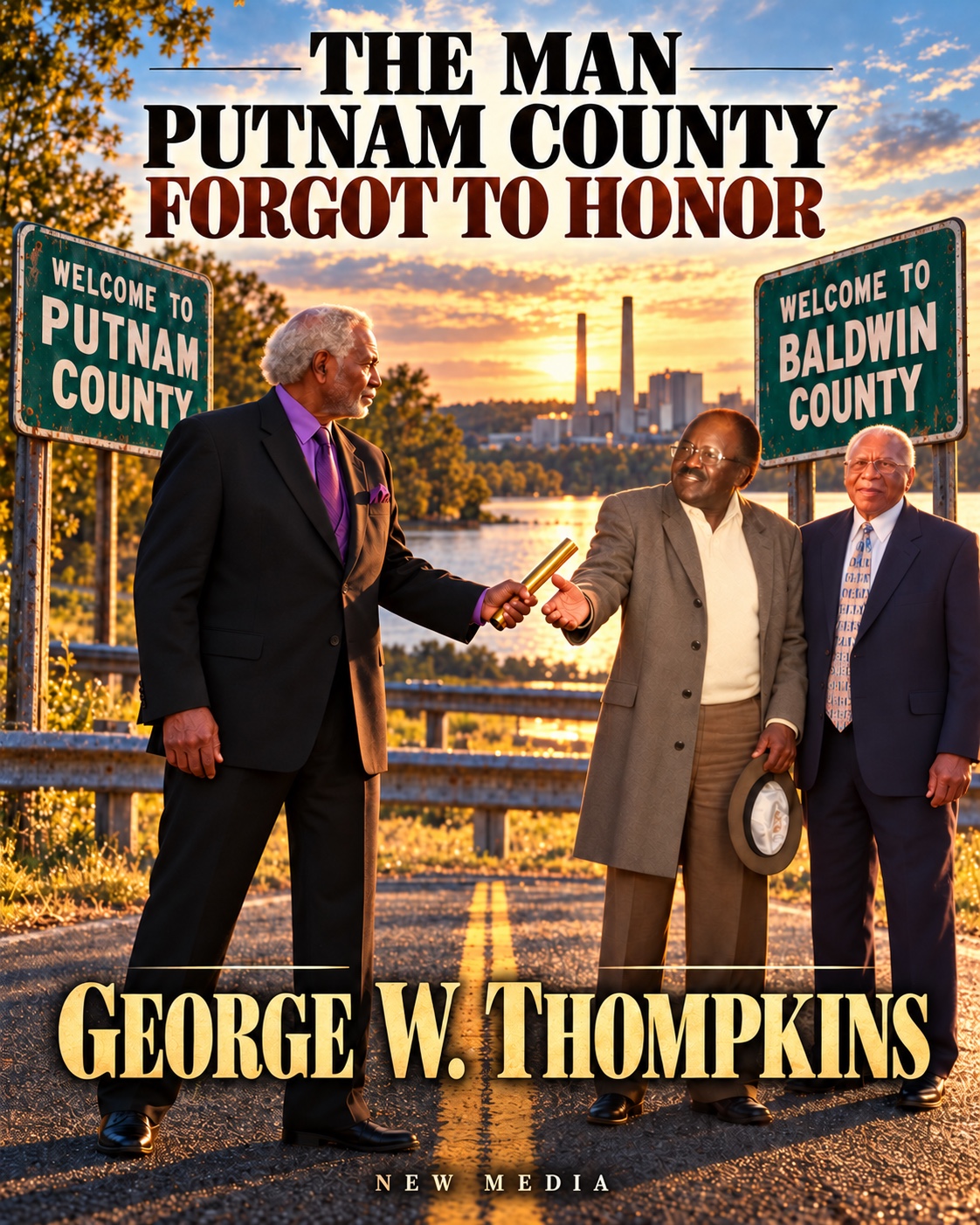
When I was in the ninth grade, I met Mr. Thompkins. At the time, I knew him as my civics teacher. He was a quiet, reserved man who dressed simply. He wore slacks, a button-down shirt and a modest tie. He didn’t walk around trying to prove that he was important, and he didn’t demand attention from anybody. Looking back now, I realize that Mr. Thompkins didn’t have to act important because he had already done important work long before I ever sat in his classroom.
As students, we called him “Chicken George.” That wasn’t his official nickname. It was something students came up with because we thought he looked like the character Chicken George from Roots. We were young, and we didn’t understand the weight of the name or the history behind the man we were talking about. We didn’t know that the quiet teacher standing in front of us had already helped break down political barriers in Putnam County decades before he ever taught us about government, citizenship and the rights of the people.
In 1981, a federal court found that Putnam County’s at-large election system had limited Black citizens’ meaningful access to political power. The court described a long history of racial segregation, unequal public employment, unequal public services and a political structure where Black candidates had repeatedly been defeated in countywide elections. The court ordered a new system with 4 single-member districts and 1 countywide seat, including 2 majority-Black districts. That decision created an opening, but somebody still had to step forward and walk through it.
George Thompkins stepped forward. In 1982, Thompkins and Jimmy Davis won their Democratic primaries and became Putnam County’s first 2 Black county commissioners. They took office in January 1983. Their breakthrough came before Baldwin County’s celebrated 1984 election, when Oscar Davis and Clarence “Smokey” Simmons became the first Black men elected to the Baldwin County Commission. That comparison isn’t meant to take anything away from Oscar Davis or Smokey Simmons. Their stories deserve to be remembered, too. But history has to be told accurately. Putnam County’s legal victory came first, and George Thompkins and Jimmy Davis were already breaking the political color barrier before Baldwin County’s historic election.
Thompkins didn’t stop fighting once he got elected. In 1999, his name appeared before the United States Court of Appeals for the Eleventh Circuit in a case involving Putnam County’s commission districts. He was one of the Black voters who fought to defend the district system that had created meaningful political representation for Black citizens. He understood that representation wasn’t just about putting a Black person in a government seat. It was about whether Black communities could elect people who understood their needs, whether Black citizens had a real voice in local decisions and whether public services finally reached people who had been ignored for generations.
Even when the fight became personal, Mr. Thompkins didn’t back down. In the mid-1990s, he took Putnam County to court over his pension and retirement benefits. Local newspaper coverage reported that he was seeking roughly $14,483.85 that he believed he was owed. The judge ultimately ruled in his favor and recognized his right to receive the money as a lump-sum payment. That part of his story matters because it shows something about his character. George Thompkins didn’t only fight for the community when he was sitting in a commission meeting. When his own rights and benefits were being challenged, he took that fight to the courts, stood on what he believed he had earned and won.
That’s the pattern in Mr. Thompkins’ life. When the system was unfair to Black voters, he fought. When the political structure threatened Black representation, he fought. When his own pension benefits were challenged, he fought. He didn’t just complain about the system. He confronted it.
That’s also why the recent recognition of Hiram E. Little deserves to be mentioned, even though this story is about George Thompkins. Putnam County recently honored Hiram Little, an Eatonton native and Tuskegee Airman, with an 8-foot bronze statue. Hiram Little served as an instructor who helped train people during one of the most important periods in American history. Hiram helped train people for the fight in the air, while George Thompkins trained minds for the fight here at home. Hiram helped prepare people to break barriers in the military, while George helped prepare students to understand government, citizenship and the power of their own minds.
One of those minds was mine. George Thompkins taught the mind that’s writing this article right now. When I was sitting in his classroom, I didn’t understand the full weight of the man in front of me. I didn’t understand that he had already helped change the political history of Putnam County, and I didn’t understand that he had fought for representation before many of us were old enough to understand what representation meant. I was a smart kid, but I was also a knucklehead. I had too much time on my hands, and I didn’t always appreciate the people who were trying to push me toward something better.
When I look back now, I can see the disappointment in Mr. Thompkins’ face. He didn’t have to say everything out loud. Sometimes a teacher can look at you and let you know that you’re capable of more. I didn’t see it then, but I see it now. I understand that he wasn’t just trying to teach me a chapter in a textbook. He was trying to teach me how to think, how to understand power and how to recognize what happens when people are denied a meaningful voice in their own government.
That’s what makes the photograph from the 2026 Eatonton Messenger article so powerful. It doesn’t show Mr. Thompkins standing behind a commissioner’s desk decades ago. It shows him sitting at a table in 2026, still participating in the public conversation. The article described George Thompkins alongside other Black seniors who were sharing their personal experiences with segregation history and encouraging voter participation in Putnam County.
At 85 years old, George Thompkins was still in the public eye. He was still talking about history. He was still connected to civic life. He was still helping people understand where they came from and why voting mattered. The photograph shows a man who didn’t simply retire from the struggle. He was still present, still speaking and still contributing.
And that’s why I have to ask Putnam County a simple question.
Where is the George W. Thompkins Park? Where is the George W. Thompkins civic building? Where is the road, scholarship, classroom or historical marker carrying the name of one of the men who helped open Putnam County’s political system? And where is even a proper photograph of George W. Thompkins?
The only photograph I could find that clearly identifies him is this recent side-profile image from 2026. That photograph is meaningful because it shows him still involved in the community, but it also raises another question. How can a man who helped change the political history of Putnam County have so little public visual record available to the people he served?
I’ve searched the county’s public facilities, recreation listings, roads and historical references, and I haven’t found a public park, road, government building or monument named after George W. Thompkins. I found Jimmy Davis Park. I found the new Hiram Little monument. But I haven’t found anything carrying George Thompkins’ name.
That’s hard to understand because George Thompkins is still here. He isn’t just a name in an old court case, a name in a government directory or a photograph in a newspaper. He’s a living witness to the struggle. He can still explain what it meant to fight for political representation in Putnam County. He can still talk about what it meant to leave the courtroom, walk into an election and become one of the first Black men to sit on the county commission. He can still talk about the students he taught, the people he represented and the barriers he helped break.
I’d love to sit down with Mr. Thompkins and interview him. I’d love to hear him talk about the lawsuit, the election, the commission, the classroom and the people who stood with him while Putnam County was changing. I’d love to tell him that the student who didn’t fully understand him back then understands him now. I’d love to tell him that the man we called “Chicken George” was actually a political pioneer, an educator and a public servant who helped open doors for people who came behind him.
If you’re in Putnam County and you know how to reach George W. Thompkins, New Media would like to hear from you. Please contact Lamar King Sr. at 404-621-6532.
Are we going to honor George Thompkins while he’s still alive, or are we going to wait until he’s in a casket before we finally give him his flowers? Are we going to wait until the people who remember him are gone before we decide that his name belongs somewhere? Or can Putnam County recognize the man while he’s still here to receive that recognition?
George W. Thompkins is still alive, still connected to the community and still capable of telling this story in his own voice. He was a teacher, a commissioner and a barrier breaker. Putnam County has an opportunity to honor him now, while he can still hear us.
Give him his flowers while he’s still here.