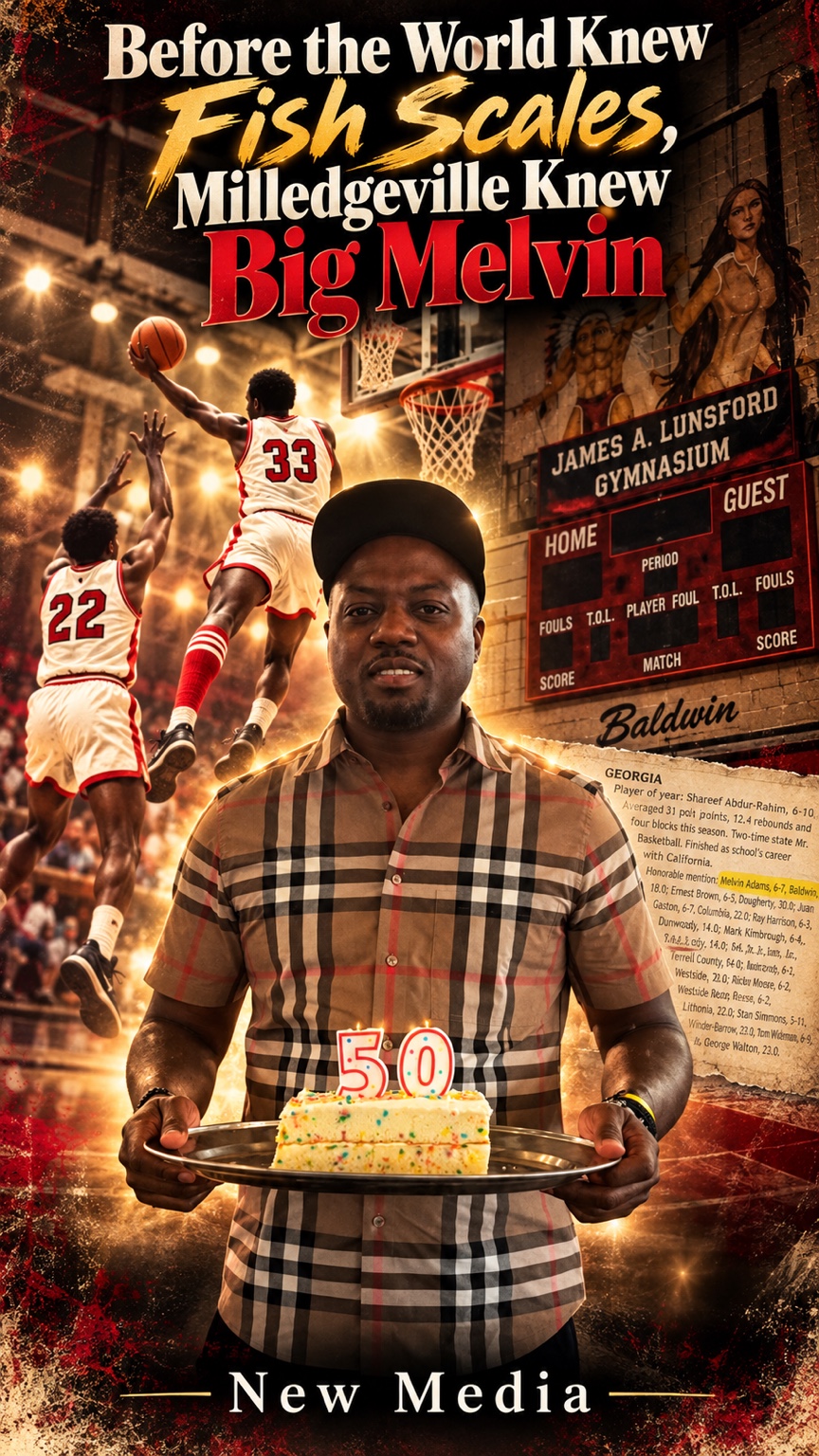
Long before the music, the television appearances, the national stages, and the business ventures, Big Melvin was just one of ours. He was a young man from Milledgeville who grew up around the same streets, neighborhoods, schools, and people that shaped so many of us.
I met Melvin on Bus 833, the Steven’s Pottery bus. Mr. Hoochie Wright was the driver, and that bus carried us through the neighborhoods that raised us. That’s where I first knew him.
Even then, Melvin had a demeanor that stood out. He was gentle, calm, respectful, and easy to be around. He was also the first proper country dude I had ever heard. That might sound like a small detail, but if you grew up in rural Georgia, you understand exactly what I mean.
People from the South have our own way of speaking. The drawl can be heavy, words get shortened, and sometimes people outside of Georgia have a hard time understanding us. When I first lived outside the state, people were constantly asking me, “Huh?”
But Melvin always spoke clearly. His English was proper, and his vernacular was measured. He was country, but he was polished. He was born and raised in Milledgeville, but he carried himself with a level of calmness and clarity that stood out.
That wasn’t something he developed after he became successful. That was Melvin as far back as I can remember. You could go back to elementary school and middle school, and he still had that same demeanor. He was always a big gentle giant. He was a big guy, but he never carried himself like somebody who needed to intimidate people.
Then basketball came along, and that’s when everybody began to see another side of him.
Baldwin High School had a squad during that era. Melvin, Kenta Kelsey, Albert Stephens, Billy Pettis, Rechard Larkin, Spencer Butts, Todd Smith, Clay Allison, Brian Ward, Andre Lewis, and Antonio “Koon” Freeman were all part of a team that had its own identity.
They wore bald heads. They would wear one long tube sock pulled all the way up to the knee, while the other foot had a footie sock. Some of them had one sleeve cut off. Before people started calling things like that a fashion trend, those boys had already created their own look.
But the style was only part of it. They could play basketball.
Melvin was the big man in the middle. He was the anchor of that team. He was physical, athletic, and relentless. He would rebound, protect the basket, finish around the rim, and make his presence felt every time he stepped on the court. Along with Kente, Melvin was one of the most important pieces of that Baldwin team.
I’ll never forget when Baldwin played Thomson High School. Thomson had a kid named Vonteego Cummings, who would eventually become a first round NBA draft pick. The first play of the game came right off the tip. The ball went up, Cummings caught it, and it looked like he came out of the sky for an alley oop.
That was the first play of the game.
Baldwin ended up beating Thomson, but that moment stayed with me because it showed the level of talent that was on the floor. Vonteego Cummings was a future NBA player, and Baldwin still had the kind of team that could compete with him.
Melvin graduated from Baldwin High School in 1995. He was listed among the top high school players in the country, averaging 18 points per game, and he earned a full scholarship to Western Kentucky.
When you look at the basketball talent that came through that era, you understand why people later questioned his decision to leave the game. This was a time when names like Paul Pierce, Shareef Abdur Rahim, and Jermaine O’Neal represented the level of talent surrounding that generation.
So when Melvin stopped playing basketball and started pursuing music, the reaction around Milledgeville was mixed. Some people supported him, but others were highly critical. They looked at his size, his talent, his scholarship, and his ability on the court and wondered why he would walk away.
People were saying, “Man, you’re going to throw away your opportunity?”
And I understood why they felt that way. Melvin was that talented. He wasn’t just a good basketball player. He was one of the most talented players many of us had ever seen come through Baldwin High School.
But Melvin wasn’t throwing his life away. He was choosing another direction.
That decision probably wasn’t easy, especially coming from the kind of household he came from. His parents were deeply spiritual and were Jehovah’s Witnesses. Faith, family, discipline, and the Kingdom Hall were all part of the world that shaped him.
I can only imagine what it was like for Melvin to sit down with his father and say, “Dad, I’m not playing basketball anymore. I’m rapping.”
Knowing Melvin, it probably wasn’t a careless conversation. He was respectful and thoughtful. He didn’t carry himself like somebody who made decisions just to make noise. Even when people didn’t agree with him, he had a way of standing on his decisions without becoming disrespectful.
By the time Melvin started coming home, he wasn’t coming by himself. He had his friends with him, young men who were building something together and pushing a brand that most people around us had never heard of before.
They were carrying Nappy Roots stickers. They were pushing CDs and tapes. They were talking about their music, passing it around, and letting people know what they were creating. We had our own studio, but what Melvin and his friends were doing was separate from that. They were coming through with their own sound, their own identity, and their own movement.
That’s when I remember Country Fried Cess coming out. It was the first Nappy Roots project I remember hearing, and they were pushing that album through the city. We were listening to it in the hood, and once that CD got into the CD player, it stayed there.
I’m willing to put Country Fried Cess up against any Nappy Roots project. That’s my opinion, but there was something raw about it. It sounded like a group of young men who were still hungry, still connected to where they came from, and still trying to prove that their sound belonged in the conversation.
They had already put in years of work before most people recognized what they were doing. They were making music, traveling, performing, and trying to find their way through an industry that didn’t owe them anything.
Then came the breakthrough.
When “Awnaw” came out with Jazze Pha, things began to change. That was the record that helped push Nappy Roots into a different level of visibility. Then came Watermelon, Chicken & Gritz, and suddenly the group was no longer something people in Milledgeville were only hearing out of somebody’s car.
We started seeing Melvin, now known to the world as Fish Scales, on 106 & Park with AJ and Free. We saw him performing on national platforms. We saw Nappy Roots becoming part of the larger culture. Watermelon, Chicken & Gritz eventually went platinum, and the group received 2 Grammy nominations, including recognition for “Po’ Folks” with Anthony Hamilton and their music film.
That was when people started realizing that Melvin had believed in himself more than people had believed in him. A lot of people thought his talent was limited to the basketball court, but he had taken that same discipline, confidence, and determination into music.
The first time I saw Nappy Roots perform live, we were already getting ready for the show. We were pre gaming at Melvin’s first cousin and former teammate, Antonio “Koon” Freeman’s apartment, on Six Flags Drive in West Atlanta. The night already had a destination. We were headed to Club Kaya in Buckhead to see Nappy Roots perform, and we were just enjoying ourselves before heading to the club.
Then David Letterman came on.
We were sitting there watching late night television, and there was Scales with David Letterman. Nappy Roots was being interviewed, and they performed. It was a surreal moment because we weren’t watching some distant celebrity we had never heard of. We were watching somebody we knew.
This was the same young man who had once been known around Milledgeville for playing above the rim and controlling the paint at Baldwin High School. Now he was sitting on a nationally broadcast late night show, talking about music and performing a hit record with the rest of Nappy Roots.
When the show went off, everybody tightened up and headed to Buckhead.
By the time we got to Kaya, the whole night had turned into a movie. It was a star studded Atlanta night. The Ying Yang Twins were there. Cash Money was there, including Birdman and Mannie Fresh. T.I. was there too, the young T.I., the wearing glasses T.I., that people remember from his early days in the industry.
Then Nappy Roots took the stage.
Another Baldwin County graduate, Kito Hawkins, was there with his letterman jacket. At some point, he took that jacket off and threw it up on the stage to Scales. Scales put it on and started jumping around, performing “Awnaw” with that letterman jacket on his back.
That was the image right there.
A kid from Milledgeville, a former Baldwin basketball player, standing on an Atlanta stage with a Baldwin High letterman jacket. I had just watched him on David Letterman, and now I was watching him perform live in front of a packed Club Kaya crowd.
I even fell on the stage at some point.
We had a ball that night. But more than anything, it was powerful to see the full circle. I had known Melvin before the music. I had seen him on the basketball court. I had watched him leave one dream behind and chase another one. Now I was standing in Atlanta watching him live out that decision in front of everybody.
Melvin didn’t just leave Milledgeville and become successful somewhere else. He carried Milledgeville with him.
Even when people connected Nappy Roots to Kentucky, Fish Scales remained the Milledgeville connection. He was the Baldwin County connection. He was proof that somebody could leave a small town, step outside the path everybody else expected, and still make sure people knew exactly where home was.
And Melvin didn’t stop with music.
He and Nappy Roots eventually expanded into business and opened Atlantucky Brewing in Atlanta. The brewery became more than a place to buy a drink. It became a creative space built around music, art, Southern culture, food, and craft beer.
When you walk into Atlantucky, it feels welcoming. It feels like you’re at your uncle’s house, sitting outside, kicking it, and talking about everything and nothing at the same time. That feeling comes from the people behind the scenes…. Scales & Nappy Roots.
Outside of the basketball court, I’ve never really seen Scales upset. The only time I saw that aggression come out was inside those lines.
Once he stepped on the court, it was a different ballgame. But outside the lines, he was humble, calm, and mild mannered. His older brother Ronnie carries that same spirit & stature.
That gentleness has followed Melvin through every stage of his life. It was there on Bus 833. It was there in elementary school and middle school. It was there at Baldwin High School. It was there when he left basketball for music, and it’s still there today.
Unfortunately in 2022, Fish Scales was robbed, forced into a vehicle, and shot while trying to escape after leaving Atlantucky. He survived the attack and eventually returned to both music and the business he helped build.
Even after that, he continued moving forward with the same humility he had displayed since childhood. He didn’t become arrogant because he succeeded, and he didn’t become bitter because he had endured difficult moments.
Melvin recently celebrated his 50th birthday at Atlantucky, surrounded by the music, business, and community he helped create.
That is what I want people to understand about Melvin Adams.
We watched him leave basketball, choose music, grind through the years, and eventually become part of something much bigger than what most people thought was possible.
Melvin didn’t throw his talent away.
He carried it with him.